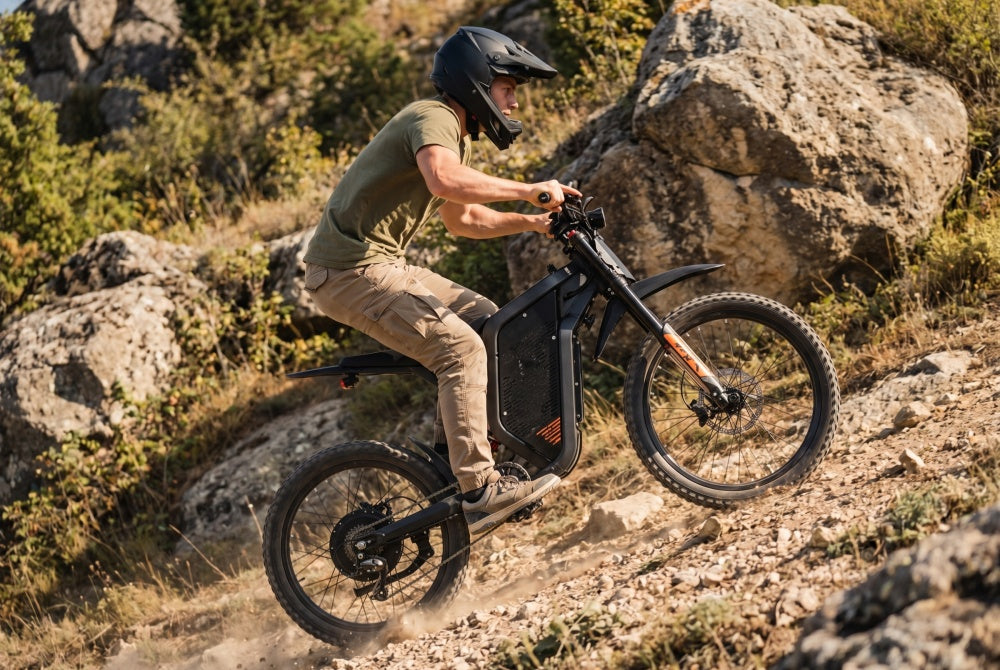
Updated July 2026
Electric dirt-bike laws without the legal fog machine
Are electric dirt bikes street legal? Usually not as normal e-bikes.
The electric motor is not the confusing part. The confusing part is that one machine can look like a bicycle in an online listing, behave like a small motorcycle on the road, and arrive with paperwork that answers neither question. The spec sheet may shout “e-bike.” The DMV may clear its throat.
Disclosure: RideStreetLegal may earn from qualifying purchases through some links, at no additional cost to you. Product claims are identified as manufacturer or seller claims, and no product placement overrides the legal analysis.
Why the answer feels complicated
There is no single “street-legal” switch.
Electric dirt-bike questions sit inside three overlapping layers. Mixing them together is how a product-safety definition turns into a very confident—but very wrong—answer about a bike lane.
Federal product and vehicle rules
Federal law defines a low-speed electric bicycle for consumer-product purposes using operable pedals, less than 750 watts, and motor-only speed below 20 mph under a specified test. NHTSA separately addresses motorcycles, motor-driven cycles, off-road vehicles, importation, VINs, and federal certification.
State vehicle categories
States decide how a machine is operated: e-bike, moped, motor-driven cycle, motorcycle, off-highway vehicle, or something that does not fit neatly anywhere. Registration, insurance, licensing, helmets, age rules and road access live here.
Local and property access
Cities, parks, trails, beaches, campuses, HOAs and private landowners can add route-specific restrictions. A legal vehicle can still be prohibited from the exact place you hoped to ride it.
Important distinction: the federal low-speed e-bike definition is not a universal permission slip for public roads. State and local operation rules still matter, and NHTSA says marketing labels such as “moped” or “mini-bike” do not decide federal vehicle classification.
CSS-only starting-category finder
What is your bike legally closer to?
This is a research shortcut, not a DMV ruling. It works without JavaScript, so WordPress or a cache plugin cannot leave you angrily clicking a decorative green rectangle.
High-risk or unclear category
Do not assume ordinary e-bike treatment.
Your selections look like a high-output pedal-equipped bike, off-road e-moto, or machine without a clean road-paperwork trail. Before public use, collect the full motor rating, top-speed capability, class label, VIN, title or MSO, federal certification label, and an insurance answer for the exact model.
Cleaner classed e-bike starting point
Your setup is closer to the normal e-bike lane.
A permanent class label, operable pedals, compliant configuration and ordinary e-bike use are the strongest starting points. Still verify your state’s Class 1, 2 and 3 definitions, age and helmet rules, plus local bike-lane, trail, sidewalk and campus access.
Potential motor-vehicle lane
Real paperwork is the right starting point—not the finish line.
An accepted VIN, title or registration category and insurance path are far stronger than a product-page claim. Confirm the exact registration class, plate, inspection, lighting, mirrors, tires, brakes, helmet rules and rider license or endorsement before use.
Private-property or OHV lane
This is usually the cleanest use case for a true electric dirt bike.
Confirm landowner permission or venue eligibility, then check permits, OHV registration or decals, age limits, helmet requirements, spark-arrestor or equipment rules, noise policies, charging, transport and insurance. Riding to the trail on public streets is a separate legal question.
The four practical buckets
Start with the machine you own—not the category you wish it were.
Bucket 1
Clearly classed e-bike
Operable pedals, a permanent class label, a compliant motor and speed configuration, and published Class 1–3 operation. This is usually the easiest lane for normal commuting.
Bucket 2
High-powered pedal-equipped bike
Pedals are present, but power, throttle behavior or speed exceeds common class limits. This is where “but it has pedals” goes to lose arguments.
Bucket 3
Off-road e-moto
Foot pegs, full throttle, motorcycle-like frame and dirt-bike performance. Treat private property and approved off-road use as the starting assumption.
Bucket 4
Moped or motorcycle candidate
The machine may have a real road path—but only when its VIN, manufacturer certification, title documents, equipment, insurance and state category line up.
Separate question
Where may it operate?
Vehicle classification does not automatically answer bike-lane, sidewalk, trail, park, campus or beach access. The route gets its own check.
Current high-output model reality check
These numbers do not look like ordinary bicycle-class specs.
Figures below are current manufacturer or seller claims reviewed in July 2026. They are useful for classification research, but not promises of real-world speed or range. Rider weight, terrain, temperature, tire pressure, mode and test conditions matter—sometimes dramatically.
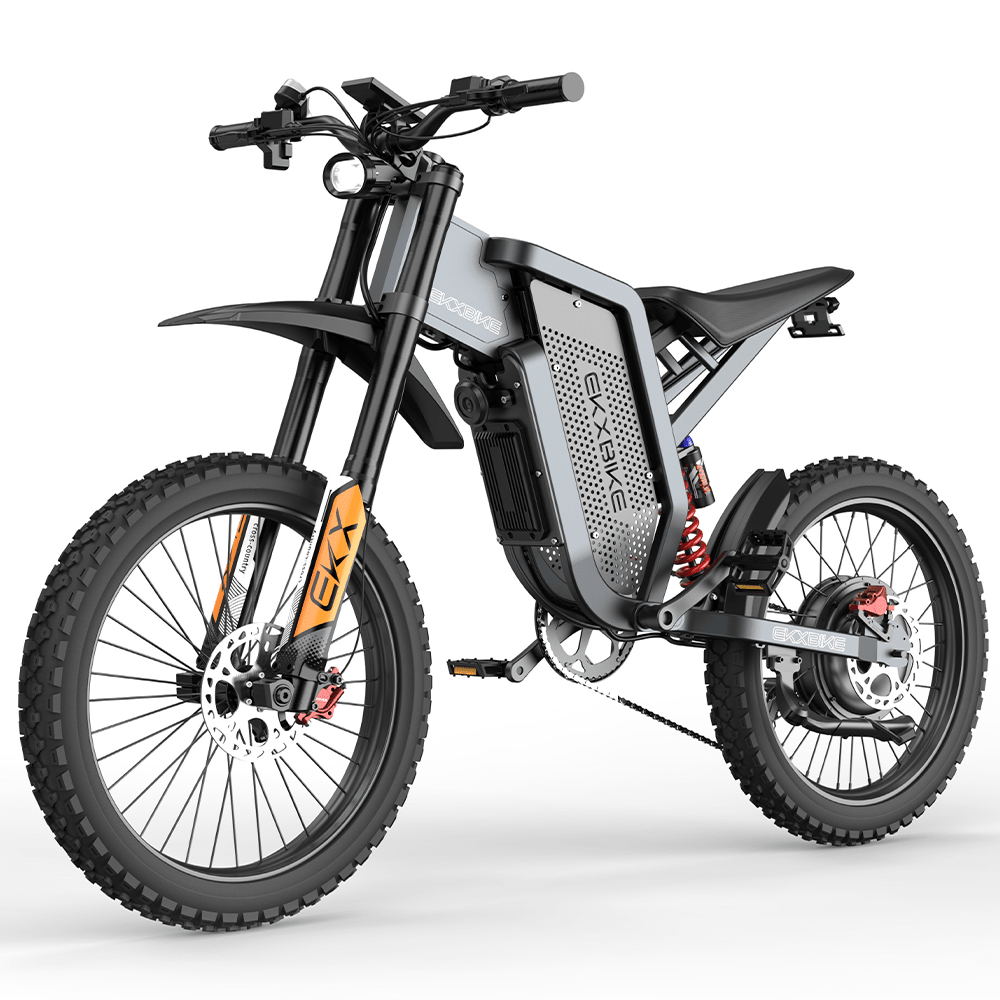
High-output pedal-equipped
EKX X21 Max
EKX currently lists 3,000W rated, 6,000W peak, a 60V 30Ah battery, up to 50 mph and up to 55 miles. Pedals are visible; the performance is not shy.
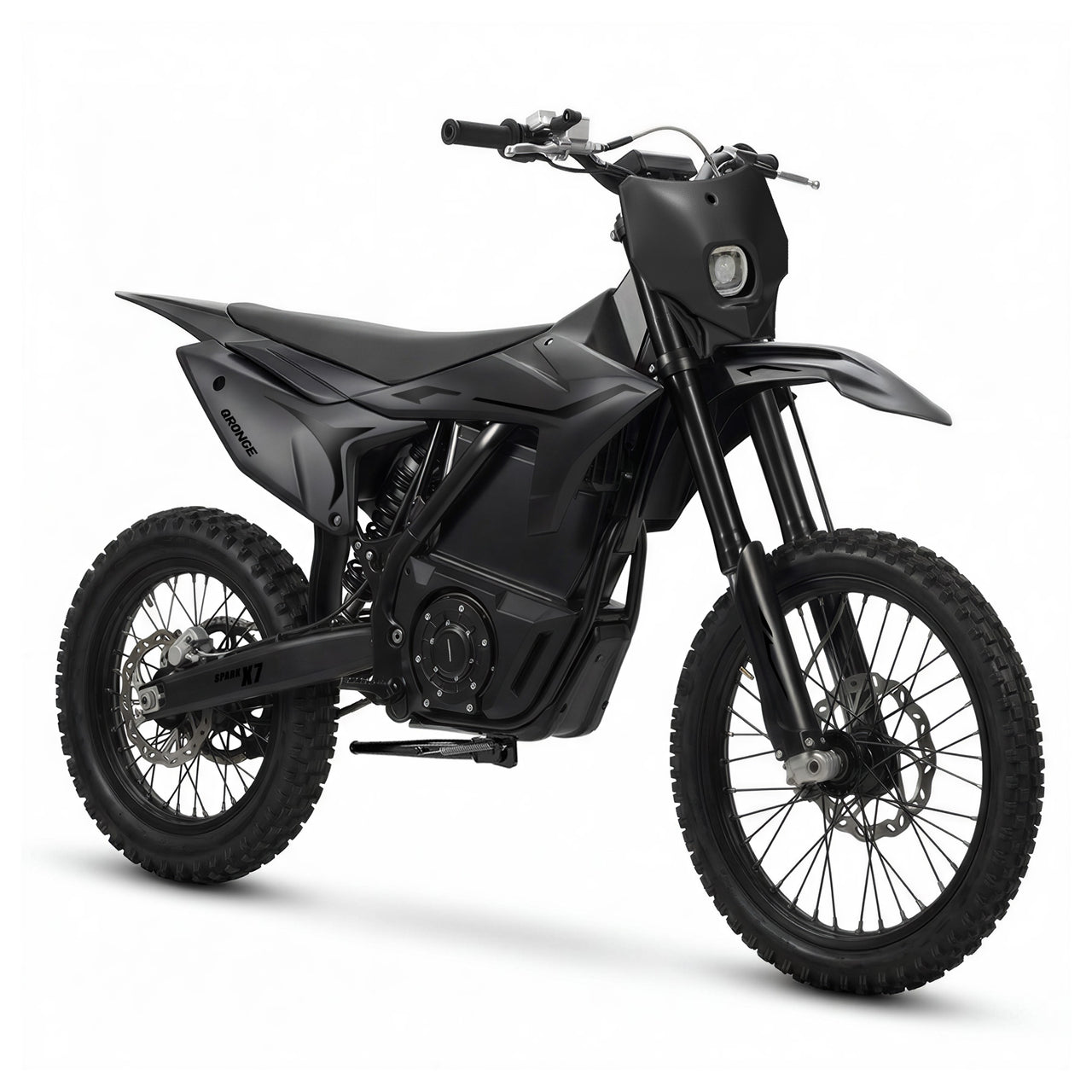
Off-road flagship
Qronge Spark family
The line runs from the X1 mini e-moto to the X5 and 12,000W-peak X7. Qronge lists the X7 at 70 mph, 72V 50Ah and 231.5 pounds—and explicitly says it is intended for off-road use.

Pedals, serious output
HiKeep MAD, MA-S and K6 T
HiKeep’s designs are among the most visually distinctive here. Current seller claims range from the dual-motor K6 T to the MAD at 5,000W rated, 8,000W peak and 52 mph. The styling is fun. The classification homework remains stubbornly un-fun.
| Model | Current positioning | Current listed performance | Legal starting point | What to verify |
|---|---|---|---|---|
| Sur-Ron Light Bee X | Off-road e-moto | Motorcycle-like foot-peg chassis and high-performance platform | Off-road or state motor-vehicle research | Exact model year, VIN/MSO, title path, insurance and route |
| Talaria Sting R MX4 | Off-road vehicle | Luna lists a 60V 45Ah battery and identifies it as off-road; sold limited to 20 mph with buyer responsibility for modifications | Off-road e-moto | Do not confuse a shipping limiter with automatic e-bike classification |
| E Ride Pro SS 3.0 | Off-road e-moto | 6kW rated / 15.8kW peak, 60 mph and 167 lb listed | Off-road or motorcycle research | VIN, certification, state registration and insurance availability |
| Altis Sigma 2026 | High-performance powersports machine | 25kW peak and 80+ mph claimed for the 2026 version | Not ordinary bicycle-class territory | Road certification, state category, transport and lawful riding area |
| EKX X21 Max | High-output pedal-equipped dirt-style bike | 6,000W peak and 50 mph claimed | State-specific classification | Do not rely on pedals or “street legal” marketing alone |
| Qronge X7 Spark | Off-road electric dirt bike | 12,000W peak, 70 mph and 231.5 lb claimed | Off-road e-moto | Venue rules, transport, protective gear and ownership support |
Official-image lookbook
The silhouette often tells you which rulebook to open first.
A machine does not become a motorcycle solely because it looks dramatic, but frame design, foot pegs, tires, suspension, weight and riding posture are useful clues. A 230-pound machine on dirt-bike wheels is not hiding inside the bicycle rack very convincingly.


The paperwork test
Ask these questions before buying conversion parts.
A box of mirrors, turn signals and a plate bracket can make a machine look prepared for the road. It cannot manufacture missing federal certification or persuade a state database to accept an unsupported VIN. Accessories are the final chapter, not page one.
Ask for a photo and confirm whether the state can actually decode and accept it.
Title, MSO/MCO, off-highway title, bill of sale and generic invoice are not interchangeable.
For an on-road motorcycle path, ask what manufacturer label certifies compliance with applicable federal standards.
Get an answer using the exact make, model and VIN before purchase.
Moped, motor-driven cycle, motorcycle and OHV categories carry different rules.
License, endorsement, helmet, age, inspection, plate and equipment requirements can all follow the category.
Where can you ride?
Owning it, registering it and accessing a route are three different achievements.
Private property
Usually the cleanest starting point.
Get permission and check trespass, noise, HOA, charging, fire-safety and insurance rules. Transporting the machine there is different from riding it there.
Approved OHV land
Confirm that electric motorcycles are allowed.
Venues can require permits, OHV registration, helmets, age restrictions, spark-arrestor equivalents or specific operating hours.
Public streets
The paperwork must match the machine.
A high-output e-moto without a valid state category, plate and insurance path creates citation, tow and impound exposure.
Bike lanes and paths
Not the place to test a legal theory.
Even registered motor vehicles are often excluded, while legal e-bike access can vary by class and local rule.
Parks and trails
Land-manager rules can be stricter.
A legal road vehicle can still be barred from a trail. Look for rules covering e-bikes, motorized vehicles and off-highway motorcycles.
Campuses and private facilities
Property policy matters.
Schools, apartment complexes, workplaces, malls and transit systems can impose their own storage, charging and operation restrictions.
Street-friendlier starting points
Keep some attitude. Lose some paperwork drama.
These are not universally legal in every place, and “street legal” on a product page is never the final answer. They are simply easier starting points than a 50–80 mph off-road e-moto when the real goal is commuting, errands or everyday transportation.
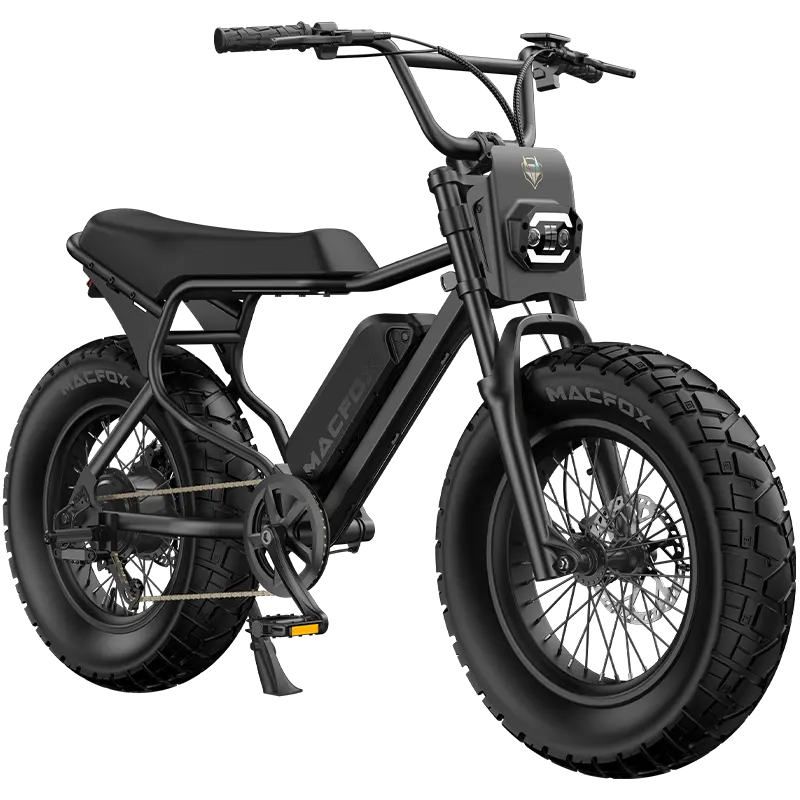
Moto look, lower factory speed
Macfox X7 / X7L
Macfox currently lists a 500W motor, 750W peak and 20 mph top speed, with up to 35 miles from one battery or 70 from two under its test conditions. It looks rebellious while the stock spec sheet is trying to behave.

Moped-style mode management
Ride1Up Revv1
The Revv1 supplies the long-seat look, full suspension and 100Nm torque. Ride1Up says it is pre-programmed as Class 2, while higher-speed modes are intended for private property. That distinction needs to survive your enthusiasm.

Rugged bicycle-style option
Lectric XPeak2
Lectric lists a 750W motor, 1,310W peak, 28 mph, up to 60 miles and Class 1, 2 or 3 operation. It is still a large fat-tire bike, but the category conversation is much cleaner than a foot-peg e-moto.


Gear that matches the real machine
Dress for the speed, not the product category dropdown.
A bicycle helmet may be appropriate for a normal classed e-bike. A machine being used near motorcycle speeds deserves motorcycle-grade protective thinking, plus a transport and theft plan that acknowledges its weight and value.
Head protection
Full-face helmet research
Check fit, certification, ventilation, visibility and replacement policy. NHTSA notes that the DOT symbol represents manufacturer self-certification to FMVSS 218; it is not an agency “approval” sticker.
Impact protection
Gloves and body armor
Hands, knees, elbows, shoulders and back tend to become extremely interested in protective equipment shortly after the first crash.
Theft and transport
Tracker, alarm and rated carrier
Verify carrier weight capacity, hitch tongue limits, loading method and tie-down points. A 167- or 231-pound e-moto is not a “close enough” moment for a 120-pound bicycle rack.
Watch the behavior, not just the thumbnail
Riding footage explains why enforcement sees more than a battery.
Sur-Ron context
Road presence and acceleration
Foot pegs, chassis shape and acceleration look very different from a conventional city e-bike once the machine is moving.
Pedal-equipped gray area
Why pedals do not finish the analysis
Use the footage to judge size, posture and performance, then return to the paperwork and state definitions.
Off-road use
The use case these machines understand
Trail suspension, tires, transport and protective gear belong in the purchase decision—not in a footnote after checkout.
FAQ
Electric dirt-bike law questions riders actually ask.
Are electric dirt bikes street legal?
Usually not as ordinary e-bikes. Some are lawful on private property or approved off-road areas, while a smaller number may qualify for a state motor-vehicle registration path. Public-road use depends on the exact machine, documentation, equipment, insurance, rider credentials, and state and local rules.
Does adding pedals make an electric dirt bike legal?
No. Pedals can matter under some definitions, but they do not override motor output, speed capability, throttle behavior, frame design, labels, VIN or title documents, registration rules, insurance, or local access restrictions.
Does a 20 mph mode make an e-moto a Class 2 e-bike?
Not automatically. Agencies may consider the machine’s full capability, accessible modes, motor rating, permanent class label, manufacturer documentation, and whether the limiter can be easily removed.
Can I ride an electric dirt bike in a bike lane?
Do not assume so. Bike lanes and shared paths are generally intended for bicycles and legally recognized e-bikes, not off-road e-motos or motorcycle-style machines. State, city, park, campus, and property rules can all matter.
Can an electric dirt bike be registered as a moped or motorcycle?
Sometimes, but not every model has a workable path. A state may require an accepted VIN, title or MSO, federal certification label, inspection, required road equipment, insurance, and the appropriate license or endorsement.
Are Sur-Ron and Talaria bikes normal e-bikes?
They are commonly sold and used as off-road e-motos. Their foot-peg design, performance, and documentation should be researched under off-road and motor-vehicle rules rather than assumed to fit normal Class 1, 2, or 3 treatment.
Is the EKX X21 Max street legal?
Do not rely on the marketing phrase alone. EKX currently lists performance far beyond ordinary low-speed e-bike definitions. Verify the exact state category, manufacturer paperwork, VIN, registration eligibility, insurance, and route before public-road use.
What is the easiest option for commuting?
A clearly labeled Class 1, Class 2, or Class 3 commuter, folding, utility, or cargo e-bike is usually easier to store, service, insure, secure, and use on permitted routes than a full electric dirt bike.
Law and model updates
Get the useful changes without the panic-posting.
RideStreetLegal sends practical updates when state guides, e-moto rules, registration information and major model specifications change.
Send me the useful updates.
No spam. Unsubscribe anytime. Laws, specifications and availability can change.
Primary sources and current product references
Use the documents—not the vibes.
- 15 U.S.C. § 2085 — federal low-speed electric-bicycle definition
- NHTSA — motorcycles, motor-driven cycles, off-road vehicles, certification and low-speed e-bikes
- PeopleForBikes — state-by-state electric-bike law resources
- Luna Cycle — Talaria Sting R MX4 current listing and off-road disclosure
- E Ride Pro — Pro SS 3.0 official specifications
- Altis Powersports — Sigma 2026 specifications
- EKX X21 Max current product page
- Qronge X7 Spark current product page and off-road-use notice
- HiKeep MAD current product page
- Macfox X7 current product page
- Ride1Up Revv1 current product page
- Lectric XPeak2 current product page
Comparing EKX, Sur Ron, or Talaria-style bikes?
High-powered e-motos need a different buying checklist than normal Class 2 and Class 3 commuter ebikes. Compare the fun factor separately from the legal question: where you will ride, whether the bike has a valid road-use path, what equipment is required, and how much risk you are comfortable with.
Other EKX models to compare
Affiliate disclosure: RideStreetLegal may earn a commission if you buy through EKX links, at no extra cost to you. Product specs, prices, availability, and legal requirements can change. Always verify the current product page and local rules before buying or riding.
Electric dirt bike law update
The first question is not speed — it is where the bike is allowed.
Electric dirt bike laws are confusing because the same machine can look like an ebike, ride like a lightweight motorcycle, and be marketed for both trail and street-style use. That is why I would not start with the brand name. I would start with classification, paperwork, and route.
What actually changes the legal question
Specs only tell part of the story. The riding position, frame shape, and overall size make it much easier to see why Sur Ron-style bikes sit in a different category from normal commuter ebikes.


Public-road checklist
What has to be checked before riding outside private land.
| Check | Why it matters | Next guide |
|---|---|---|
| VIN/title path | Public-road use often depends on paperwork, not just lights or pedals. | /do-electric-dirt-bikes-need-vin-numbers |
| Registration and insurance | If the bike is treated as a moped or motorcycle, paperwork can matter immediately. | /can-you-register-an-electric-dirt-bike |
| Road equipment | Lights, mirrors, horn, signals, plate mount, and tires may matter depending on classification. | /can-you-make-a-sur-ron-street-legal |
| Where it will be ridden | Roads, OHV areas, trails, bike lanes, parks, and campuses are different rule sets. | /sur-ron-laws |
Affiliate disclosure: RideStreetLegal may earn a commission if you buy through EKX, Amazon, ADO, ENGWE, or other partner links, at no extra cost to you. Product specs, availability, shipping, pricing, local laws, and road-use requirements can change. Always verify the current product page and your local rules before buying or riding. Educational only, not legal advice.
Specs that change the legal question
The numbers explain why these are not normal commuter ebikes.
Legal pages get stronger when they show the actual spec gap. A 60V off-road e-moto, a 45Ah Talaria, a 50 mph EKX X21 Max, and a full-size Stark VARG are not in the same lane as a 20–28 mph commuter ebike.
| Model | Why riders compare it | Battery / power reference | Speed reference | Legal-use takeaway | Next step |
|---|---|---|---|---|---|
| Sur Ron Light Bee X | Lightweight off-road e-moto baseline | 60V battery platform; Luna listing shows 34Ah with 38Ah upgrade options | Commonly discussed around the mid-40 mph off-road lane; verify current model-year specs | Luna states the bike is sold as an off-road vehicle, not for street use. | Official SurronRetail reference |
| Talaria Sting R MX4 | Closest Sur Ron-style rival | 60V 45Ah / 2700Wh battery listed by Luna | Factory limited to 20 mph; Luna notes over 40 mph if the limiter is removed | Luna states it is sold as an off-road vehicle, not for street use. | Retail reference |
| EKX X21 Max | Budget e-moto with pedals | 60V 30Ah battery; 3000W rated / 6000W peak listed by EKX | 50 mph claimed by EKX | Pedals can make it feel more bicycle-adjacent, but this still needs an e-moto legal check. | Check EKX X21 MaxLegal check |
| EKX TX1 | Budget dirt-bike-style EKX | 60V 30Ah battery; 3000W rated / 6000W peak listed by EKX | 45 mph claimed by EKX | More dirt-bike-first than commuter-first; research off-road/private-land use first. | Check EKX TX1 |
| Stark VARG EX / MX | Premium full-size electric motorcycle lane | Full-size electric off-road platform; verify configuration on Stark’s site | Far beyond normal ebike category | Treat as a motorcycle/off-road motorcycle purchase, not an ebike replacement. | Stark VARG EXStark VARG MX |
| Stark VARG SM | Purpose-built road/supermoto lane | Street/supermoto version from Stark | Road-use category depends on market, homologation, and local registration | This is the lane riders should study when they want a purpose-built road-use electric motorcycle rather than an ebike gray area. | Stark VARG SM |
The clean explanation
Pedals can soften the bike’s feel, but they do not erase the spec sheet.
This is the safest EKX angle: the pedal setup can make the bike feel more bike-adjacent than a pure no-pedal electric dirt bike, but once speed and power move into e-moto territory, the buyer still needs to check registration, equipment, insurance, and where the bike is allowed.
Affiliate disclosure: RideStreetLegal may earn a commission if you buy through EKX, Amazon, or other partner links, at no extra cost to you. Sur Ron, Talaria, and Stark links here are included as editorial reference links unless otherwise stated. Specs and road-use status can change by model year, trim, retailer, state, and configuration. Always verify the current product page and your local rules before buying or riding. Educational only, not legal advice.