
Street legality guide
Are Talaria bikes street legal? Usually not in standard off-road form.
Talaria bikes such as the Sting R MX4 and Sting MX5 Pro are usually treated more like high-powered electric dirt bikes than ordinary Class 1, Class 2, or Class 3 ebikes. That does not make them bad machines. It means the legal question is bigger than adding a headlight, mirrors, or a turn-signal kit.
The practical test is simple: if a Talaria can exceed normal ebike class limits, lacks a clear road-use VIN and registration path, or is sold primarily as an off-road machine, assume public-road use is legally risky until your state DMV, local rules, insurance provider, and product paperwork prove otherwise.
Unless the exact bike has a valid road-use paperwork path where you live.
Quick answers before you buy or ride
Do not skip this
A 20 mph limiter does not automatically make a Talaria street legal.
Some Talaria listings describe factory speed limiting or road-legal variants. That still does not mean every buyer can ride one like a normal ebike on public roads. For street use, the important questions are whether the exact unit has compliant paperwork, the right certification label if required, a registration path, insurance eligibility, required equipment, and permission under state and local rules.
Talaria legal reality checker
Start with classification, not top speed.
This quick checker cannot replace your state DMV or local law, but it shows why Talaria-style bikes usually fall outside the easy ebike lane.
Why the answer is usually no
Electric does not automatically mean ebike.
The federal low-speed electric bicycle definition is built around fully operable pedals, an electric motor below 750 watts, and a low motor-powered speed limit. Many states then use Class 1, Class 2, and Class 3 categories that revolve around 20 mph throttle assist, 20 mph pedal assist, or 28 mph pedal assist.
Talaria bikes sit in a different performance world. Luna Cycle’s Talaria Sting R MX4 page describes it as a powerful trail bike, and its MX5 Pro listing places that model even deeper into off-road e-moto territory. When a vehicle is built and marketed around electric dirt-bike performance, the legal conversation shifts from “is this an ebike?” to “can this be legally registered, insured, equipped, and operated as a road vehicle where I live?”
That distinction matters because federal and state systems do not treat every two-wheeled electric machine the same way. A low-speed ebike framework generally centers on fully operable pedals, a motor under 750 watts, and assistance limits around 20 mph or 28 mph depending on class. NHTSA’s motorcycle guidance also makes clear that motorcycles and motor-driven cycles are classified by vehicle design and compliance, not just by marketing names.
Talaria vs common legal categories
| Category | Typical limits | Where Talaria usually fits | Buyer reality |
|---|---|---|---|
| Class 1 ebike | Pedal assist only, assist generally stops at 20 mph, usually 750W or less. | Not a good match for standard Talaria off-road models. | Better for bike paths, commuting, fitness, and lower legal risk. |
| Class 2 ebike | Throttle capable, motor assistance generally stops at 20 mph, usually 750W or less. | Talaria-style e-motos typically exceed the spirit and performance of this class. | Useful for city errands and delivery when the bike is truly class compliant. |
| Class 3 ebike | Pedal assist generally up to 28 mph; state rules vary on throttles and access. | Still not a clean fit for a high-powered electric dirt bike. | Often the safest faster commuter route if you want road use without moped/motorcycle paperwork. |
| Moped or motor-driven cycle | State-specific power, speed, equipment, license, and registration rules. | Possible legal bucket in some states, but only if the bike and paperwork qualify. | The problem is usually eligibility, not just equipment. |
| Motorcycle or off-road vehicle | VIN, title/MSO, FMVSS certification, plate, insurance, license, or OHV access may matter. | Often the more realistic frame for Talaria, Sur Ron, E Ride Pro, and Altis-style machines. | Great for legal off-road use; complicated for public-road commuting. |
The models people compare
Talaria, Sur Ron, E Ride Pro, Altis, and EKX are not ordinary commuter ebikes.
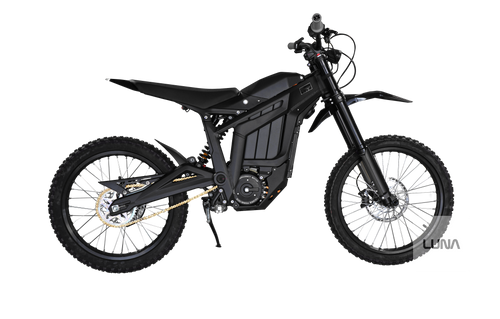
Talaria Sting R MX4
The Sting R MX4 is the kind of bike that creates the legal question in the first place: exciting, capable, and much closer to an electric dirt bike than a conventional street-legal bicycle.

Talaria Sting MX5 Pro
The MX5 Pro belongs in the high-performance e-moto conversation. Treat it as an off-road-performance machine first, then verify any road-use claims with your state and paperwork.
What to compare instead
If you wanted a Talaria, choose the right lane before choosing the bike.
Some readers want Talaria-style off-road performance. Others actually want a fast-looking commuter, a safer city ebike, or a practical alternative that will not create the same road-use headache. These options should not be treated as interchangeable.

Altis Sigma
Best for riders who want a premium e-moto alternative and already understand that this is not a simple Class 2 commuter ebike. Keep the road-use warning prominent.

E Ride Pro SS 2.0
A serious Talaria and Sur Ron cross-shop for off-road riders. It belongs in performance comparisons, not in a casual street-legal ebike ranking.

EKX X21 Max
Useful for readers comparing e-dirt bikes by price and performance. The legal framing should remain clear: more power usually means more road-use questions.

Ride1Up Revv1
Best for shoppers who like the aggressive Talaria look but want pedals, a consumer ebike brand, and a more commuter-friendly ownership path. Still check local Class 2/Class 3 rules.

Lectric XPeak 2.0
A stronger fit for riders who want trails, fat tires, commuting, and a mainstream ebike ownership experience instead of e-moto legal uncertainty.

ADO / ENGWE commuter lane
If the real goal is commuting, apartment storage, delivery, or city errands, a folding or commuter ebike from ADO or ENGWE is usually easier to live with than a Talaria.
Road-use checklist
Before riding a Talaria on the street, answer these questions.
Enforcement reality
Many riders get away with it until something draws attention.
Talaria enforcement is often inconsistent. A rider may go weeks without trouble on quiet roads, then face a ticket, impoundment, or insurance problem after a complaint or crash. The most common triggers are visible speed, throttle-only riding, no plate, no insurance, parks, schools, sidewalks, bike lanes, and group rides that look like illegal dirt-bike activity.
Gear that actually matters
If you ride e-moto speeds, dress for e-moto consequences.
Check Amazon
Check Amazon
Check Amazon
Helpful search angles
What to watch before buying a Talaria
Video reviews can help you understand ride feel, weight, brakes, suspension, battery behavior, and real-world speed. Use them for ownership research, then use this page for the legal filter.
Search YouTube
Search YouTube
Best next pages to read
Read class guide
Compare legal-friendly bikes
FAQ
Talaria street legality questions
Are Talaria bikes street legal in 2026?
Can I make a Talaria street legal with a kit?
Is a Talaria an ebike?
Can I ride a Talaria in bike lanes?
Do pedals make a Talaria legal?
Do I need insurance for a Talaria?
What should I buy if I want to commute?
What should I buy if I want Talaria performance?
Final recommendation
Buy the legal category first, then the bike.
If you want a Talaria because you love electric dirt-bike performance, keep it in the off-road lane unless your paperwork and local rules clearly support road use. If you want daily transportation, a compliant commuter ebike is usually the smarter choice.
This guide is general educational information, not legal advice. Always verify current state law, local ordinances, DMV rules, park and trail rules, insurance requirements, and enforcement policies before riding.