Are 50 MPH Ebikes Legal?
Quick answer: A 50 mph “ebike” should usually be treated as an e-moto or electric motorcycle-style vehicle, not a normal street-legal ebike. Pedals or the word “ebike” in a product title do not automatically make it legal for bike lanes or public-road use.
Quick Answer Box
- 50 mph is far beyond normal low-speed ebike class limits.
- These vehicles may require registration, insurance, licensing, or off-road-only use.
- Bike lanes, sidewalks, paths, and parks are not the right assumption.
- Check VIN/title and motor-vehicle rules before buying.
Key takeaway: Do not buy by headline specs alone. Check the class, speed, throttle behavior, battery safety claims, and where you plan to ride.
What Buyers Should Know First
RideStreetLegal is built around one simple idea: before you buy an electric bike, check whether it actually fits your route, your local rules, and your risk tolerance. Product pages often make every bike look like a simple commuter, but the legal reality can change fast when the bike is high-powered, speed-unlocked, throttle-heavy, or closer to an e-moto than a bicycle.
50 MPH Is E-Moto Territory
At 50 mph, the risk profile changes. Brakes, tires, frame design, lighting, rider gear, insurance, registration, and crash liability become much more serious than they are on a normal commuter ebike.
Why Product Titles Are Misleading
Some online listings use ‘ebike’ because the vehicle is electric or has pedals. Legally, the more important question is how fast it assists, how it is powered, whether it can be registered, and whether it has compliant paperwork.
What to Do Before Buying
If the vehicle can reach 50 mph, check whether it has a VIN, title, registration pathway, insurance options, DOT equipment if applicable, and a realistic legal place to ride.
Related Video to Watch
High-Speed Ebikes and E-Moto Legality Explained
Use video reviews and explainers as visual context, then verify the actual product specs and local rules before buying.
Recommended Riding Gear
Gear does not make a non-compliant bike legal, but a real commuter setup should include visibility, security, and basic safety items from day one.
- MIPS commuter helmet — A real commuter helmet should be part of the budget before any high-speed or city setup. Check Price on Amazon
- Heavy-duty ebike U-lock — Most riders underestimate theft risk until they start parking a $1,000+ ebike outside. Check Price on Amazon
- Rechargeable front/rear lights — Backup lights improve visibility even if your bike already has built-in lights. Check Price on Amazon
- Vibration-proof phone mount — Useful for maps, speed awareness, delivery apps, and route planning. Check Price on Amazon
- Ebike mirror — A simple mirror helps in traffic, especially on Class 3 commuter bikes. Check Price on Amazon
- GPS tracker / alarm — Smart for city parking, campus riding, apartment storage, and higher-value bikes. Check Price on Amazon
How This Fits the RideStreetLegal Funnel
If you are comparing actual bikes now, start with the Don’t Buy the Wrong Ebike checklist. Then compare safer options in the best street-legal ebike guide, the Amazon electric bikes guide, or the Walmart ebike guide.
For classification questions, read the Class 2 vs Class 3 ebike guide. For high-powered e-moto-style machines, start with the Sur Ron laws hub and electric dirt bike laws hub.
FAQ
Is a 50 mph ebike street legal?
Usually not as a normal ebike. It may fall into moped, motor-driven cycle, motorcycle, or off-road categories.
Can pedals make a 50 mph bike legal?
No. Pedals alone do not overcome speed, power, registration, and classification issues.
Can I ride a 50 mph ebike on trails?
Only where that type of motorized vehicle is specifically allowed.
Do 50 mph electric bikes need plates?
They may if treated as motor vehicles, and some may not be registerable at all.
What should I compare instead?
Class 3 commuters for legal road use, or real electric motorcycles/e-motos for speed with proper paperwork.
Final Recommendation
The safest buying path is usually the simplest: choose a clearly labeled Class 2 or Class 3 commuter ebike from a seller with transparent specs, real support, a return policy, and credible battery-safety information. If the bike has vague wattage, speed unlocks, no pedals, or e-moto styling, check the rules before buying.
Start here: run the RideStreetLegal ebike legal checker, then compare bikes only after you know what legal category actually fits your ride.
Educational note: this article is general buyer education, not legal advice. Laws change by state, city, trail, road type, park, campus, and enforcement agency. Always verify current local rules before riding or buying.
Sources to Verify Current Rules
- U.S. CPSC electric and non-powered bicycle standards summary
- PeopleForBikes electric bike policies and laws
- UL 2849 ebike electrical-system certification overview
Looking at a high-speed ebike or budget e-moto?
Once a bike moves into 35–50 mph, 1000W+, or electric dirt bike territory, the shopping question changes. The bike may be fun and still be a poor fit for bike lanes, sidewalks, parks, campuses, or public-road commuting.
Other EKX models to compare
Affiliate disclosure: RideStreetLegal may earn a commission if you buy through EKX links, at no extra cost to you. Product specs, prices, availability, and legal requirements can change. Always verify the current product page and local rules before buying or riding.
50 mph ebike reality check
At 50 mph, you are usually outside normal ebike territory.
A 50 mph electric bike should not be researched like a basic Class 2 or Class 3 commuter ebike. At that speed, the safer assumption is that you are looking at a moped, motorcycle, off-road electric dirt bike, or high-risk e-moto category unless your local rules clearly say otherwise.
Why 50 mph changes the category
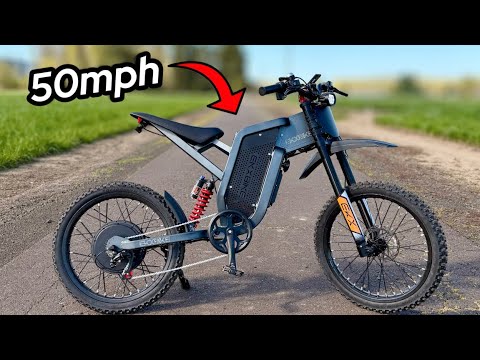
Specs only tell part of the story. The riding position, frame shape, and overall size make it much easier to see why Sur Ron-style bikes sit in a different category from normal commuter ebikes.

Why this matters
Speed changes the buying checklist.
| Normal ebike question | 50 mph e-moto question | Why |
|---|---|---|
| Is it Class 2 or Class 3? | Can it be registered or legally operated? | A 50 mph top speed can push the bike outside low-speed ebike rules. |
| Does it have pedals? | Does it have a VIN/title path? | Pedals alone do not create legal road status. |
| Can I ride in bike lanes? | Where is this vehicle category allowed? | Bike infrastructure usually is not written for 50 mph machines. |
| What helmet should I buy? | Do I need motorcycle-level protection? | The safety setup changes with speed and traffic exposure. |
Affiliate disclosure: RideStreetLegal may earn a commission if you buy through EKX, Amazon, ADO, ENGWE, or other partner links, at no extra cost to you. Product specs, availability, shipping, pricing, local laws, and road-use requirements can change. Always verify the current product page and your local rules before buying or riding. Educational only, not legal advice.
Specs that change the legal question
The numbers explain why these are not normal commuter ebikes.
Legal pages get stronger when they show the actual spec gap. A 60V off-road e-moto, a 45Ah Talaria, a 50 mph EKX X21 Max, and a full-size Stark VARG are not in the same lane as a 20–28 mph commuter ebike.
| Model | Why riders compare it | Battery / power reference | Speed reference | Legal-use takeaway | Next step |
|---|---|---|---|---|---|
| Sur Ron Light Bee X | Lightweight off-road e-moto baseline | 60V battery platform; Luna listing shows 34Ah with 38Ah upgrade options | Commonly discussed around the mid-40 mph off-road lane; verify current model-year specs | Luna states the bike is sold as an off-road vehicle, not for street use. | Official SurronRetail reference |
| Talaria Sting R MX4 | Closest Sur Ron-style rival | 60V 45Ah / 2700Wh battery listed by Luna | Factory limited to 20 mph; Luna notes over 40 mph if the limiter is removed | Luna states it is sold as an off-road vehicle, not for street use. | Retail reference |
| EKX X21 Max | Budget e-moto with pedals | 60V 30Ah battery; 3000W rated / 6000W peak listed by EKX | 50 mph claimed by EKX | Pedals can make it feel more bicycle-adjacent, but this still needs an e-moto legal check. | Check EKX X21 MaxLegal check |
| EKX TX1 | Budget dirt-bike-style EKX | 60V 30Ah battery; 3000W rated / 6000W peak listed by EKX | 45 mph claimed by EKX | More dirt-bike-first than commuter-first; research off-road/private-land use first. | Check EKX TX1 |
| Stark VARG EX / MX | Premium full-size electric motorcycle lane | Full-size electric off-road platform; verify configuration on Stark’s site | Far beyond normal ebike category | Treat as a motorcycle/off-road motorcycle purchase, not an ebike replacement. | Stark VARG EXStark VARG MX |
| Stark VARG SM | Purpose-built road/supermoto lane | Street/supermoto version from Stark | Road-use category depends on market, homologation, and local registration | This is the lane riders should study when they want a purpose-built road-use electric motorcycle rather than an ebike gray area. | Stark VARG SM |
The clean explanation
Pedals can soften the bike’s feel, but they do not erase the spec sheet.
This is the safest EKX angle: the pedal setup can make the bike feel more bike-adjacent than a pure no-pedal electric dirt bike, but once speed and power move into e-moto territory, the buyer still needs to check registration, equipment, insurance, and where the bike is allowed.
Affiliate disclosure: RideStreetLegal may earn a commission if you buy through EKX, Amazon, or other partner links, at no extra cost to you. Sur Ron, Talaria, and Stark links here are included as editorial reference links unless otherwise stated. Specs and road-use status can change by model year, trim, retailer, state, and configuration. Always verify the current product page and your local rules before buying or riding. Educational only, not legal advice.