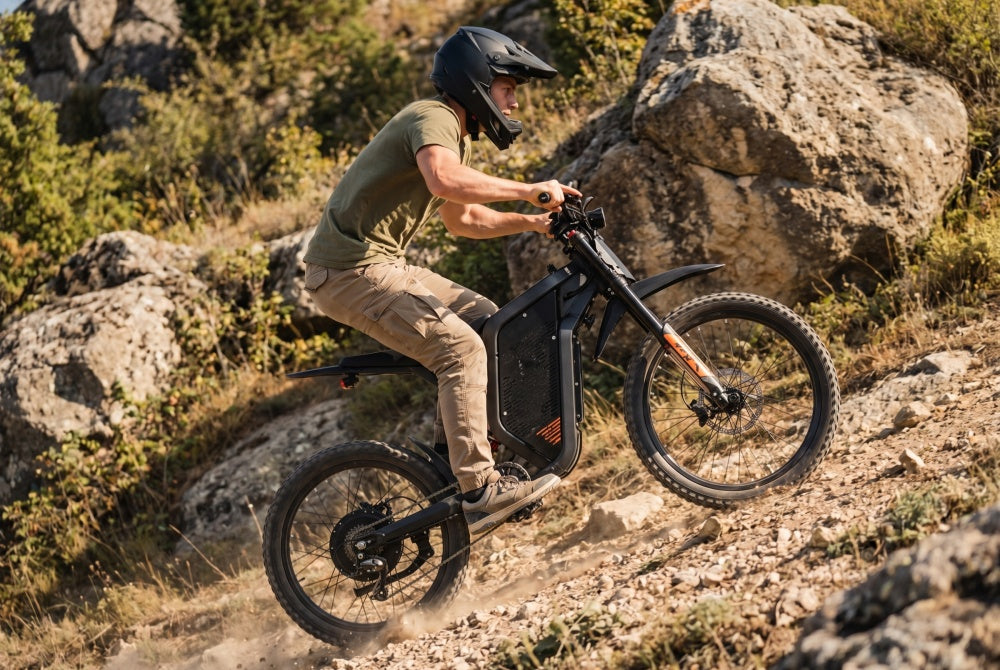
Electric dirt-bike law and buyer hub
Updated July 2026 · E-bike classes, e-moto paperwork, registration risk, alternatives, and buyer guides
Are electric dirt bikes street legal? Classify the bike before you buy it.
Start with the question that matters most to you—whether that is state law, registration, impound risk, a specific model, or finding a bike that is easier to live with on public roads.
RideStreetLegal may earn from qualifying purchases through some links, at no additional cost to you. Recommendations are organized by legal category, intended use, support, storage, and ownership risk—not by commission.
Electric dirt-bike guide series
Start with the decision that is holding you back.
You may be trying to answer a completely different question than the next rider. Choose the guide that matches the decision in front of you, then come back here when you are ready to compare bikes.
Sur-Ron Laws by State
Use the state hub when the bike is a Sur-Ron, Talaria, E Ride Pro, Qronge, or another full-throttle e-moto.
Can Police Take Your Sur-Ron?
Learn what usually creates stop, citation, tow, impound, registration, and recovery risk.
Best Qronge Electric Dirt Bikes
Compare the X1, X5, and X7 Spark as off-road-first electric motorcycles instead of ordinary e-bikes.
Is the EKX X21 Max Street Legal?
See why pedals do not erase the X21 Max's speed, output, documentation, and route questions.
Are Lectric Bikes Street Legal?
Compare a mainstream Class 1, 2, or 3 brand with the full electric dirt-bike category.
Best Street-Legal E-Bikes
Start here when commuting matters more than motorcycle speed, trail suspension, or off-road acceleration.
Three legal lanes
The same machine can be fun, well-built, and still belong in the wrong place.
Lowest-friction lane
Class 1, 2, or 3 e-bike
Best starting point for commuting, errands, bike lanes, storage, and bicycle-style transportation. Confirm the selected class and local path rules.
Off-road-first lane
Electric dirt bike or e-moto
Best when the real use is private property, trails, tracks, or designated off-road areas. Do not treat motorcycle-scale power as a bicycle loophole.
Road motor-vehicle lane
Moped or motorcycle registration
Best when public-road speed is the real goal and the exact model has documents, equipment, insurance, and a registration path your state accepts.
Interactive category checker
Which legal category should you investigate first?
Use the original factory specifications. If the seller advertises an unlockable speed or off-road mode, choose the highest advertised capability.
Model comparison
Popular electric dirt bikes create different legal and ownership problems.
Seller-listed specifications help explain the performance category. They do not, by themselves, prove bicycle status, road registration, insurance acceptance, or access to bike infrastructure.
| Model | Vehicle style | Current performance signal | Street-use concern | Best next step |
|---|---|---|---|---|
| Sur-Ron Light Bee X | Lightweight off-road e-moto | Motorcycle-like output, suspension, throttle, and foot-peg design | High: normally requires analysis beyond normal e-bike classes | Open the state-specific Sur-Ron law hub |
| Talaria Sting R MX4 | Off-road e-moto | High-output 60V platform commonly compared with the Light Bee | High: a low-speed setting does not guarantee e-bike status | Confirm VIN or MSO, state category, and legal riding locations |
| EKX X21 Max | Pedal-equipped e-moto | 60V 30Ah; 3000W rated / 6000W peak; up to 50 mph seller claim | High: pedals do not erase output, speed, or paperwork issues | Read the dedicated EKX legality guide |
| E Ride Pro SS 3.0 | 72V electric dirt bike | 72V 50Ah battery; 167 lb; off-road-first acceleration and hardware | Very high: full-throttle foot-peg chassis | Plan for lawful off-road use unless the exact VIN has a valid road path |
| Qronge X1 Spark M | Compact full-throttle e-moto | 4500W peak; 60V 28.8Ah; up to 50 mph seller claim | Very high: compact size does not create bicycle status | Treat as an off-road electric motorcycle |
| Qronge X7 Spark | Full-size off-road e-moto | 12000W; 72V 50Ah; up to 70 mph seller claim | Extreme: presented as an off-road-use product | Use on lawful private property or designated off-road areas |
| HiKeep MAD | Pedal-equipped high-output dirt-style bike | 5000W rated / 8000W peak; 60V 80Ah; 52 mph seller claim | Very high: pedals do not override motorcycle-scale output | Verify the exact state category before public use |
| Altis Sigma | High-output electric dirt bike | 97.2V 35Ah; 25kW peak; 198 lb seller-listed weight | Very high: motorcycle-scale power and weight | Buy for off-road performance, not as a bicycle-class commuter |
| Macfox X7 | Moped-style, pedal-equipped e-bike alternative | 500W rated / 750W peak; 20 mph listed top speed | Lower starting risk: still verify the exact state class and route | Use when style matters more than motorcycle speed |
| Lectric XPeak 2.0 | Classed fat-tire e-bike | 750W rear hub motor; 28 mph; Class 1, 2, or 3 operation | Route check: Class 3 and throttle access can vary | Match the selected class to roads, lanes, paths, and trails |
High-performance examples
These make the most sense when you truly have somewhere legal to ride them.
These bikes can be a blast when you have legal off-road access, the right protective gear, secure storage, and a way to transport them. They become a frustrating commuter purchase when those details are treated as an afterthought.

72V off-road platform
E Ride Pro SS 3.0
Best fit: riders with legal off-road access, motorcycle-grade protective gear, secure storage, and a transport plan.
A 20 mph delivery setting does not automatically convert the unrestricted, full-throttle dirt-bike chassis into a Class 2 bicycle.

Motorcycle-scale performance
Altis Sigma
Best fit: experienced off-road riders who want extreme output and understand the transport, storage, gear, and access requirements.
The output, weight, suspension, braking hardware, and motorcycle-style layout place it far beyond ordinary bicycle-class expectations.

Pedal-equipped e-moto
EKX X21 Max
Best fit: budget-conscious riders who want dirt-bike styling and off-road performance—and will not rely on pedals as a legal shortcut.
The X21 Max is the clearest example of why a pedal kit cannot erase several kilowatts of output, high speed, and a dirt-bike-focused design.
More bikes worth comparing
Qronge and HiKeep look exciting—but the legal category still matters.
Electric motorcycle lineup
Qronge X1, X5, and X7 Spark
The X1 is the compact entry point, while X5 and X7 move into full-size, motorcycle-scale output and speed. Treat all three as off-road-first machines.
High-output pedal-equipped models
HiKeep MAD, MA-S, and K6 T
HiKeep stands out because the bikes look different from almost everything else in the category. The angular frames, body panels, long seats, and moto-inspired stance are a big part of the appeal. Just remember that the same design that makes them look exciting does not make the legal classification any simpler.
Design spotlight
Why HiKeep stands out: the design is part of the appeal.
The first thing I notice about HiKeep is not the wattage—it is the shape of the bikes. The angular battery frame, long bench seat, and motocross-inspired stance make them feel more like a custom build than a typical commuter e-bike. That visual appeal is real, even though the legal questions still need to be taken seriously.
The MAD has the strongest cyberbike look, the MA-S feels more compact and aggressive, and the K6 T has a smaller fat-tire scrambler style. These three images give you a clear sense of how different the models feel before you compare the legal and practical details.


Street-friendlier alternatives
Want the look without the full e-moto headache?
You do not have to give up the rugged or moto-inspired look to choose a bike that is easier to live with on public roads. These options still need a local rules check, but they start much closer to normal e-bike territory than a 50–70 mph dirt bike.
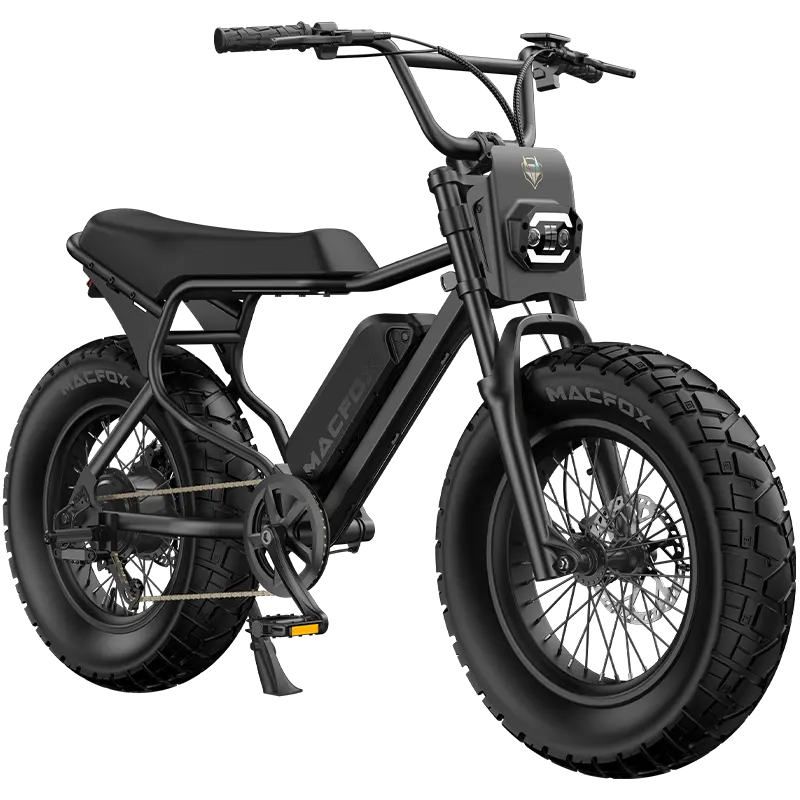
Moped-style legal starting point
Macfox X7 / X7L
Best fit: riders who want fat-tire, moped-inspired styling but do not need 50 to 70 mph electric motorcycle performance.
Keep it in a compliant factory setup and verify the exact state class, throttle rules, helmet rules, and path restrictions.

Rugged classed e-bike
Lectric XPeak 2.0
Best fit: rough pavement, potholes, gravel, commuting, and riders who want fat tires while staying in a published Class 1, 2, or 3 framework.
The XPeak is not a Sur-Ron substitute in the legal sense. It is a classed e-bike, but Class 3 and throttle use can still be restricted on paths, parks, campuses, and trails.

Moped-style middle ground
Ride1Up Revv 1 DRT
Best fit: riders who want a substantial moto-inspired e-bike experience while retaining pedals and published e-bike modes.
Use road-compliant settings on public routes. Treat off-road or unlocked performance as a private-property or lawful off-road feature, not a bike-lane entitlement.
Light folding commuter
ADO Air 20 Ultra
Better when apartment storage, carrying, normal bicycle handling, and low-friction commuting matter more than full suspension and dirt-bike performance.
Compact city option
ENGWE P20
Better for everyday city transportation, storage, errands, and a conventional e-bike ownership experience.
Ownership workflow
Do the boring checks before the expensive purchase.
1 · Define the route
Where will it actually be ridden?
Public streets, bike lanes, sidewalks, campuses, parks, trails, private property, and designated off-road areas can all have different rules.
2 · Identify the category
Do not accept “street legal” as a category.
Compare the exact specs with e-bike, moped, motor-driven-cycle, motorcycle, and off-highway definitions.
3 · Verify the documents
Ask for the label, manual, VIN, title, or MSO.
A headlight, turn signals, pedals, or a speed limiter cannot replace documents a state agency requires.
4 · Call insurance first
Get an answer for the exact make, model, and VIN.
Do not assume coverage will appear after the bike arrives. A gray-market or off-road-only model can be difficult to insure.
5 · Budget for transport
Many e-motos are too heavy for ordinary bike racks.
Include a truck, van, trailer, or properly rated hitch carrier when lawful riding areas are not accessible from home.
6 · Secure the bike
Plan storage, locks, alarm, and tracking.
High-value e-motos are visible theft targets and often cannot be carried upstairs or stored beside a normal bicycle.
Watch the scale and riding posture
Ride footage shows the difference faster than a spec table.
Off-road e-moto
Sur-Ron speed and road presence
Notice the acceleration, foot-peg position, chassis, and scale beside ordinary bicycles.
Pedal-equipped e-moto
EKX X21 Max review
Useful for seeing why pedals do not make the riding posture or performance bicycle-like.
Rugged classed e-bike
Lectric XPeak 2.0 contrast
A useful comparison for riders who want fat tires and rough-road capability without buying an electric motorcycle.
Gear before speed
Protective and security gear does not change the legal category—but it still matters.
Helmet
DOT-compliant full-face helmet
Motorcycle-like speed and vehicle mass call for more protection than a casual bicycle helmet.
Security
Heavy lock, alarm, and tracker
A cable lock is not enough for a visible, high-value e-moto stored outside or left during errands.
Riding protection
Gloves, boots, knees, elbows, and armor
Hands, ankles, knees, elbows, and shoulders deserve motorcycle-appropriate protection as speed and weight increase.
Get the buying checklist
Keep the paperwork and street-use questions ready before checkout.
The checklist helps you verify category, powered speed, throttle behavior, documents, battery information, registration, insurance, equipment, storage, transport, and replacement support.
Email me the “Don’t Buy the Wrong E-Bike” checklist.
No spam. Unsubscribe anytime. Product specifications and laws can change.
FAQ
Electric dirt-bike street-legality questions.
Are electric dirt bikes street legal in the United States?
There is no single nationwide answer for public-road use. Federal consumer-product law, state vehicle definitions, registration rules, local road access, park rules, trail policies, licensing, insurance, and the exact bike configuration can all matter.
Does a 20 mph mode make an electric dirt bike legal?
Not automatically. A limited mode changes current performance, but legal treatment can still depend on the machine's full capability, pedals, motor output, class label, design, VIN or title documents, manufacturer certification, and state law.
Do pedals make an electric dirt bike an e-bike?
No. Pedals are only one factor. Power, assisted or powered speed, throttle behavior, labeling, equipment, design, and state definitions still matter.
Can an electric dirt bike be registered as a motorcycle?
Sometimes, but the exact model and state control the answer. A usable path may require an acceptable VIN, title or MSO, road-use certification, required equipment, insurance, inspection, and the correct operator license.
Are Sur-Ron and Talaria bikes street legal?
They are commonly sold and used as off-road e-motos. Public-road legality depends on the exact model, documents, state category, registration path, insurance, required equipment, and local access rules.
Is the E Ride Pro SS 3.0 street legal?
Do not assume ordinary bicycle-class treatment. Its foot-peg chassis, full-throttle performance, weight, suspension, and off-road-first design require a state-specific motor-vehicle or off-road analysis.
Are Qronge X1, X5, and X7 Spark bikes street legal?
Do not assume normal Class 1, 2, or 3 status. Qronge markets these as electric motorcycles or electric dirt bikes with speed and output far beyond common e-bike limits. The X7 Spark is presented as an off-road-use product.
Is the HiKeep MAD street legal because it has pedals?
No automatic conclusion follows from pedals alone. HiKeep lists motorcycle-scale output and speed, so state power, speed, throttle, equipment, labeling, and vehicle definitions still control the answer.
Is the Macfox X7 a more street-friendly alternative?
It is a cleaner starting point than a 50 to 70 mph electric dirt bike because it is a pedal-equipped, lower-speed moped-style e-bike. Riders still need to verify the exact state class and local route rules.
What is the easiest category for commuting?
A clearly labeled Class 1, Class 2, or Class 3 commuter, folding, utility, or cargo e-bike is usually easier to store, service, secure, and use on permitted public routes than a full electric dirt bike.
Sources and reference points
Verify the exact model and current rules before buying or riding.
- 15 U.S.C. § 2085 — federal low-speed electric-bicycle definition
- NHTSA motorcycle and motor-driven-cycle definitions
- Sur-Ron Light Bee X official page
- E Ride Pro SS 3.0 specifications
- Altis Sigma specifications
- EKX X21 Max specifications
- Qronge X1 Spark M specifications
- Qronge X7 Spark specifications and off-road-use positioning
- HiKeep MAD specifications
- Macfox X7 specifications
- Lectric XPeak 2.0 official product page